Showing posts with label XC90. Show all posts

Wednesday, 7 January 2015

Volvo: product news

6/12/14
Product news: Orders begin for 2015 Volvo XC90

Volvo has finally begun taking orders for the hotly anticipated new XC90. After twelve years in production, the time finally came to retire the old model, the replacement for which has already built up quite a reputation for itself.

With a limited run of 'First Edition' XC90s among the first cars to be sold, Volvo's flagship SUV has started strong - all 1927 examples of the 'First Edition' XC90 sold out in little under two days. At times, orders were nearing seven per minute; a promising start for Volvo's first all-new all-Volvo car since before the Ford takeover.

Spearheading Volvo's new design language, the XC90 (pictured) is driven exclusively by the brand's frugal Drive-E engines - cementing the notion that safety and efficiency are at the top of Volvo's list of priorities. This reestablishment of what Volvo does best is important for Volvo after the Swedish carmaker's values became somewhat diluted during its shaky start to the 21st century under Ford.

Volvo's Media Relations Manager, Martin Bayntun, marked this event as particularly important, as the XC90 is "a landmark car for Volvo and the first product launch in a new era for the company." Of particular note are the new XC90's "cutting edge plug-in hybrid drivetrains, innovative interior design and connectivity, pioneering safety technologies and a unique Swedish take on premium car design,"

First deliveries of the new XC90 are set to take place in May 2015.


http://www.newspress.co.uk/ViewPressRelease.aspx?pr=54882
Interview material: original content obtained via email interview with M. Bayntun


8/12/14
Product news: Volvo reveals innovative new XC90 with twin-engine technology

Volvo's main source of news is the XC90, and with good reason. The XC90 T8 is a plug-in hybrid of the already groundbreaking new Volvo SUV, with a petrol engine coupled with a small but potent electric motor. Lauding the new T8 as "the world's most powerful and cleanest 7-seat SUV" is a bold move, but Volvo's ground-up approach to creating the hybrid giant has ensured that the combination of both engines find their place in the XC90, as well as work together to provide a variety of power deliveries, with selectable all-wheel-drive to boot.

A 2-litre, 4-cylinder Drive-E turbo- and supercharged petrol engine sits at the front and provides 314bhp, while the 81bhp electric motor is located just above the rear axle. Transmission is Volvo's 8-speed automatic gearbox, with "special adaptations" for the T8 hybrid.

Above: packaging is important - the placement of Volvo's new twin-engine technology in the XC90 T8 hybrid.

Volvo claim the XC90 T8 delivers 395bhp and 640Nm of torque, powering the car from 0 to 62mph in one tenth under six seconds, with a tiny CO2 output of just 59g/km, although it's not clear on which driving mode this figure is attained. Power is delivered in a variety of different ways from the two engines, with the usual electric-only and hybrid modes seen on most petrol-electric motors, with a 'Power Mode' for added performance, in which the electric motor provides low-end grunt while the petrol motor gets up to speed, for smooth and consistent power delivery. See the video below for a demonstration.

Video source: MotoringView, YouTube.

This cutting-edge technology again is tangible evidence of Volvo's main ideologies. As mentioned previously as a 'safety news' story, the XC90 has been rigorously tested in crash situations, the footage of which has been released for public viewing. This stringent testing, coupled with the frugality, cleanness and potency of the T8 XC90 mark it out as a symbol of all that Volvo stands for in 2014 and beyond.

Above: green credentials - the XC90 will have a variety of power delivery options, including full-electric mode.

 http://www.newspress.co.uk/ViewPressRelease.aspx?pr=54889
Video: https://www.youtube.com/watch?feature=player_embedded&v=Z76ETlXYuQc

Volvo: future

Volvo's future is nothing if not bright. Under new, refreshing management while retaining the management qualities of the independent Volvo which thrust them into greatness in the first place is pushing Volvo to the forefront of modern motoring.

Volvo's policy on downsizing engines is already in full swing, with its safety innovations carrying on as if the Ford debacle never even happened. A prototype turbocharged, three-cylinder engine is currently undergoing testing in the V40, but is likely to see placement in the S60 and V60 too, under its 'Drive-e' eco badging. A turbocharged four-cylinder engine is also set to feature in every model across the Volvo range, prompting concern from critics who anticipate that this may put customers off from buying higher-end Volvos, feeling that the product they are buying is not significantly different enough from lower-spec models to warrant the extra cost.


Left: Coming soon - Volvo's teeny-tiny turbo triple. Right: Come and gone - the XC90 'First Edition' sold out in 47 hours.

This new engine lineup accompanies Volvo's long-term plan to introduce a nine-model lineup is entering fruition and sits on SPA (Scalable Product Architecture) modular underpinnings, marking another step away from its tumultuous last decade and Ford. This
is much the same system employed by Volkswagen in its ubiquitous MQB platform, and if Volvo can mimic the MQB's success with this platform, their plans for global growth will be fully and thoroughly realised. Another lineup change to expect is the arrival of a spate of coupé models. The three concepts featured on Volvo's glossy website all embody a different coupé variant; the Concept Estate - more akin to a three-door shooting brake than an estate; the Concept XC Coupe - Volvo's answer to the BMW X6; and the Concept Coupe - a handsome coupé which would fill the dormant boots of the C70.

This new, 9-model lineup, based around '40, 60, 90' nomenclature, with the existing system of 'S' badges for 'sedan' cars, 'V' badges for 'versatile' estates, and 'XC' for 'cross-country' models. This means a new flagship S90 sedan at the top of the Volvo lineup, with a V90 estate variant - a first for the segment which has notably always been devoid of estate cars. So perhaps the future for Volvo is to fire the starting pistol on the race to built estate cars in the luxury car segment - meaning we can expect cars such as the Audi A8 Avant, BMW 7-Series Touring and Mercedes-Benz E-Class Estate to shortly follow the V90. Couple this with the aforementioned coupé concepts, and it's easy to make out the shapely silhouettes of a C40, C60 and C90 on the horizon, providing Volvo's current plans for growth under Geely are accomplished.

Above: Coming soon? Volvo's lineup is lacking in coupés. Could the hugely popular Concept Estate be the answer?

Geely's ownership of Volvo is not without its skeptics. Industry critics fear that should Volvo not deliver upon the highly ambitious targets set for it, it could be unceremoniously dropped by Geely, such is the ruthless reputation of chairman of Zhejiang Holding Group Co, Li Shufu. Some publications even refer to Volvo's parent group as its "Chinese overlords". This is unfair though. Martin Bayntun, Volvo's Media Relations Manager, when asked for comment stated that "New ownership has brought independence, allowing us to move more quickly in the marketplace to meet customer needs, and introduce new technologies. With it has also come investment in next generation platforms and drivetrains, and new opportunities in the Chinese market - all of which will help us double global sales in the next decade."

What, then, can we expect from Volvo? After the cruel pruning of the C70 coupe/cabriolet and the charming C30 hatchback and the announcement and promise of the second-generation XC90, it's safe to say we can expect growth. And lots of it. More growth than a beanstalk in a grow-bag full of MiracleGro. It may still be finding its feet with some models dynamics-wise, but that hasn't stopped Volvo from bringing in 2015 with a whole bag of promise and anticipation. It's a fairly safe bet that before much longer that hallowed nine-model lineup will be upon us, and Volvo will be back to its former glory.

http://www.economist.com/news/business-and-finance/21615677-volvo
http://www.gizmag.com/volvo-scalable-product-architecture-spa-xc90/33377/
http://blog.caranddriver.com/swede-plan-bro-volvo-plans-new-compact-crossover-and-sedan-luxe-90-series-models/
http://www.forbes.com/sites/matthewdepaula/2014/12/30/mighty-mite-new-three-cylinder-engine-has-big-role-in-volvos-future-with-v40-s60-s40/
http://autoweek.com/article/car-news/future-volvo
http://www.thecarconnection.com/news/1094175_volvo-high-mpg-three-cylinder-engine-headed-to-future-s60
http://www.volvocars.com/us/cars/concept-cars

Interview material: original content obtained via email interview with M. Bayntun

Tuesday, 11 November 2014

Volvo: a brief history

It's easy to overlook Volvo. That might sound unkind, but in the tumultuous recent automotive climate of niche-busting Audis, futuristic offerings from BMW and the demise of Volvo's Swedish rival Saab, it is undeniable. Be that as it may, Volvo's quiet competence should not go unnoticed.

Originally the subsidiary car-producing arm of Swedish ball bearing manufacturer SKF, April 14th 1927 is usually slated as Volvo's inception. The first ÖV 4 (or 'Jakob' to enthusiasts) rolled off the production line in Gothenburg on this date, and Sweden's second city still plays host to Volvo's headquarters today.

Above: A 1928 Volvo ÖV 4 'Jakob' Touring. Image: Lars-Göran Lindgren Sweden.

Within five years and one month of starting out, Volvo had sold more than 10,000 cars in 1932. The next five years also saw another 10,000 sales, however the coming wartime years all but put a stop to Volvo's car production, as the company "transformed its production to serve the armed forces".

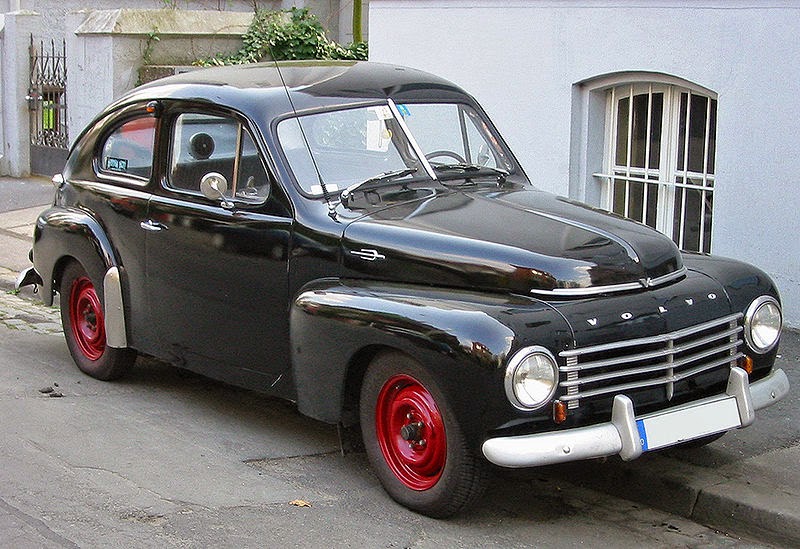
Volvo's post-war period is where the manufacturer really came into its stride though. Not only did the PV444 and following PV544 give Volvo a convincing foot in the door of the lucrative American car market, the PV544 and Amazon led the way in road safety, being the first cars to feature three-point safety belts - which themselves were invented by Nils Bohlin.

Above: Volvo's grappling hook for the American market: the PV444. Image: Cropbot.

Volvo's safety drive didn't stop there though; in the interest of saving lives, Volvo let other manufacturers use their new three-point seatbelt technology in a move which has reputedly saved 'over one million lives'. This helped Volvo to cement its late-20th-century reputation as the go-to manufacturer for vehicle safety. Only recently has the rest of the automotive industry caught up, closing the gap between Volvo's remarkable safety standards and its key competitors.

But the latter part of the 20th century was Volvo's true golden age. The hugely successful 200 series sold nearly three million units during its marathon, 19-year production run between 1974 and 1993. As Volvo's best-selling car, it could be said that the 200 series is responsible for Volvo's rather staid image of rock-solid, safe and practical cars. But more of that later.

Above: The iconic 240, part of the world-beating 200 Series. Image: Vaa.

With a name which literally translates from Latin to 'I roll', it's clear that Volvo has gathered no moss, especially in the face of new, safer competition. Changing hands twice since the turn of the century of course took its toll on Volvo's credibility, with industry critics such as Autocar acknowledging this period as "a concerning time. But Volvo pulled through, and in the last few years has flourished under its new Chinese ownership, with models such as the XC90, gaining universal critical acclaim. This blog will later explore the highs, lows and every in-between of Volvo's across its 87-year history.

With such a rich history, it is blindingly obvious why Volvo has such a dedicated following. With their safety-first image, it's just as clear why they're still ever popular today, and with such an exciting future to boot, you can't deny that Volvo is a growing concern for the 'big three' in luxury carmaking. Volvo's Media Relations Manager, Martin Bayntun, compared Volvo's founding principles with those of today: "Assar Gabrielsson and Gustav Larson founded the Volvo Car Company in 1927 on the premise that: “Cars are driven by people. The guiding principle behind everything we make at Volvo, therefore, is and must remain, safety.” That philosophy is as true today as it was then. To that end then, our past as a manufacturer of safe vehicles continues to influence our cars today. A modern Volvo is a premium car with the very latest technology, desirable design, fuel efficient powertrains and pioneering safety equipment."

Above: The XC90, a successful exploration into new terrain for Volvo. Image: Volvo.

http://www.volvoclub.org.uk/history/milestones.shtml
http://www.volvoclub.org.uk/history/
http://www.volvoclub.org.uk/history/year_stats_search.php
http://www.volvocars.com/uk/top/about/values/pages/safety.aspx
http://www.autocar.co.uk/car-review/volvo/v40

Interview material: original content obtained via email interview with M. Bayntun