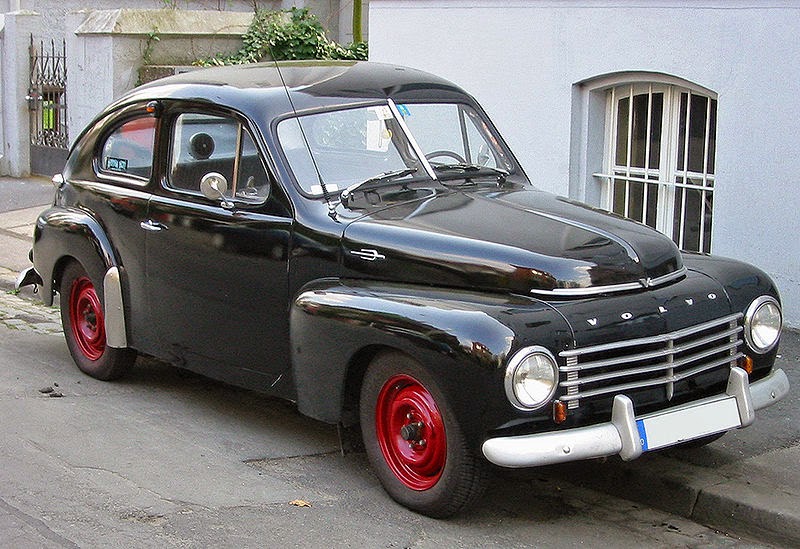
Wednesday, 7 January 2015

Volvo: rivals

As a blog post on Volvo's rivals, his piece could be very short, because due to its unique market position and ideologies, Volvo has no tangible rivals across the board. When asked about Volvo's market position and relationship with rivals, Martin Bayntun, Volvo's Media Relations Manager, defined Volvo's policies fairly succinctly, saying that for Volvo, "Market position isn’t really a consideration, we build cars that customers want to buy – premium, safe, desirable cars that deliver a contemporary luxury experience."


Thanks to a combination of a unique and relentless pursuit of safety, and the firm only ever chasing mainstream success under its infamous Ford ownership, Volvo's 'rivals' all but died out with Saab. It can be argued that Volvo's pricing and quality place it in league with the premium sector (the domain of Audi, BMW and Mercedes), yet terms such as 'competition' and 'rivals' seem too aggressive when discussing those who Volvo shares a market with. If the car market was analogised as a battlefield, Volvo would be an intellectual strategist.

Above: the stomping ground of 'the big three', the executive saloon market is tight and distinct.

Why intellectual? Because Volvo's safety and efficiency-first policies deal with a niche which the 'big three' de facto rivals of Volvo prioritise lower down the list of attributes with which their brand is associated. For Audi, the priority is: "sportiness, progressiveness and sophistication". For BMW, it's: "Sporting and dynamic performance combined with superb design and exclusive quality", while Mercedes' is, more vaguely: "Reject compromise, protect what matters, honour a legacy, consider every detail, take responsibility, and outperform expectations." By putting a vast amount of resources into development of genuinely innovative safety features, as well as putting in a conscious and palpable effort to downsize engines in the interests of lowering emissions; mopping up all the customers that the above (arguably) forget.

Above: where before Audi was Volvo's only competitor in these markets, there are seemingly new entries every year. 

And why a strategist? Because Volvo, rather than chasing customers with relentless advertising campaigns, PR schemes and other expensive media, instead chooses to innovate their marketing strategies; pulling out of the majority of motor shows and focusing upon the three most relevant to the Volvo brand - Detroit, Geneva and Beijing, representing the three most important markets to Volvo. Following the overwhelming success of the first edition of the new XC90 which sold all 1927 examples in just 47 hours online, Volvo is working on expanding and improving its online and social media activity and services.


Above: 'rivals' to the V40 premium hatchback. Below: subtle differences bring in an entirely different class of competitor.


Semantics aside, Volvo's range spans across eight highly-competitive, premium-sector classes of car, with more variants in each class, and numerous competitors in each sector, see the diagrams adorning this post. In this period of change, it is possible that even more competitors will emerge and attempt to share the same market space as Volvo and its already plentiful rivals. As other brands shift upmarket, as Volkswagen seems to be doing, and Volvo continues to produce sector- and segment-spanning models like the V40 Cross Country (above), Volvo could see its competitors sharply increase.
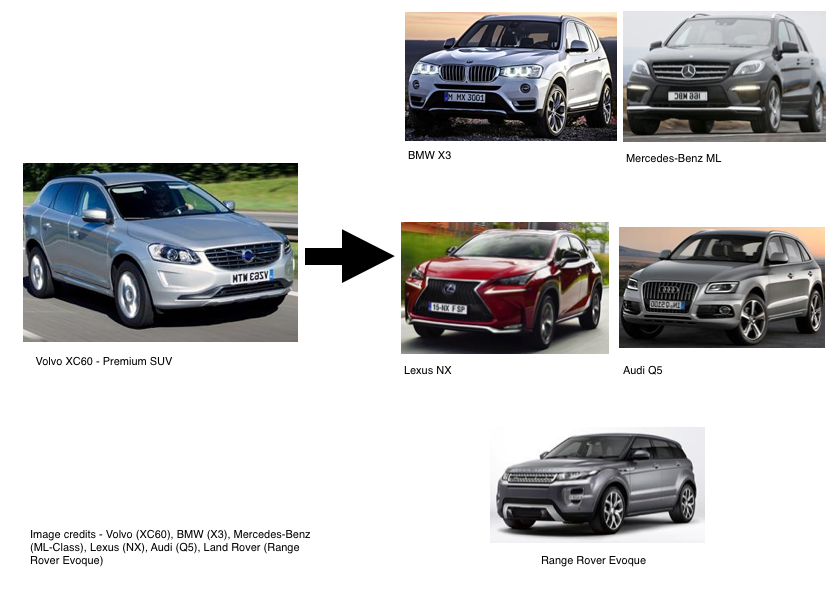
Above: the XC60's market is rigidly ruled by 'the big three', with no blurring of niche boundaries.

There is no doubt that the coming years of Volvo while its Chinese ownership is still in its infancy, it faces challenges as yet unknown in their number but perfectly clear in their manner: exactly how big will Volvo's market share be? Progressive sub-brands like BMW's 'i' lineup certainly seem to be closing the disparity between the brand values of all the major players in the market and indeed across the industry, and quite what impact this will have on Volvo's market share is, for the moment, unclear.

Above: the XC90 faces ferocious competition in one of the most crowded markets Volvo competes in.

In fact, in complete contradiction to the first sentence of this post, it could be argued that due to its unique market position and ideologies combined with the changing nature of the market, Volvo has many tangible rivals across the board; even more so than those competing in a sector without blurring the lines.

Above: in one of the UK's bestselling markets, Volvo is without a doubt a left-field option.

http://www.audi.com/corporate/en/company/corporate-strategy.html
http://retailindustry.about.com/od/retailbestpractices/ig/Company-Mission-Statements/BMW-Group-Mission-Statement.htm
http://retailindustry.about.com/od/retailbestpractices/ig/Company-Mission-Statements/Mercedes-Benz-USA-Mission-Statement.htm
http://www.volvogroup.com/GROUP/GLOBAL/EN-GB/VOLVO%20GROUP/VISIONMISSION/PAGES/VISION.ASPX
http://www.autoexpress.co.uk/volvo/89801/volvo-to-shun-future-motor-shows
http://www.businessweek.com/articles/2014-06-26/volvo-seeks-u-dot-s-dot-sales-revival-with-return-to-swedish-roots

Interview material: original content obtained via email interview with M. Bayntun

Saturday, 3 January 2015

Volvo: ownership

Volvo's 2011 rescue by Chinese automotive giant Geely marked the end of a troublesome spell for the Gothenburg brand; not the first time it has seen off adversity. Martin Bayntun, Media Relations Manager for Volvo, discussed Volvo's new owners and what Volvo hopes they will bring: "New ownership has brought independence, allowing us to move more quickly in the marketplace to meet customer needs, and introduce new technologies. With it has also come investment in next generation platforms and drivetrains, and new opportunities in the Chinese market - all of which will help us double global sales in the next decade."

In a way, Volvo's ownership has gone full circle, with seemingly as many twists and turns (yes, it's an odd circle) and ways to trade as it's possible to trade under. Over its 90 year history, Volvo's story begins in 1924, when ball bearing manufacturer SKF branched out into automobiles, producing the first Volvo in 1927. Initially simply a minor subsidiary of SKF, Volvo went on to branch into commercial vehicles, heavy machinery and even marine engines.

It took only a few years of trading for Volvo to become hugely successful. SKF's selloff of the Volvo Group happened in 1935, after the group was floated on the Stockholm stock exchange. From then until 2000 Volvo operated as an independent company with Volvo cars as its automotive subsidiary, and this period saw huge growth as the Gothenburg manufacturer went from strength to strength. 

(Left - SKF's headquarters in Gothenburg, courtesy of Mangan2002)

Above: the legendary P1800 was produced under an independent, and is one of the brand's most iconic cars. 

Never a mainstream carmaker, Volvo's state of independence saw through distinctive and successful models such as the Amazon, 200 Series and 850, marking a 'golden age' for Volvo. The Autumn of 1955 saw a particular milestone in Volvo's independent lifetime, as for the first time it began exporting cars to the USA. From here, Volvo's success skyrocketed, with particular success in 1986. After this, however, the advent of Japanese luxury marques saw Volvo's market share shrink as its competitors grew exponentially in number. 

From that moment on, Volvo's problems started. Facing a dramatic decline in sales after losing a hefty share of the market to the likes of Lexus, Volvo went into freefall. Eventually, in 1999 Volvo Group parted ways with Volvo Cars, selling to Ford for $6.45billion in 2000. Now sitting in Ford's Premier Automotive Group along with Aston Martin, Jaguar and Land Rover, Volvo started the 21st Century as part of an automotive giant, with its parts being shared across a range of Ford Motor Company products. 

Although the range of Volvo products grew under Ford, Volvo's future was unsteady. With mounting monetary troubles, Ford looked to Volvo to alleviate its worries. Hundreds of workers were laid off, sparking rumours that not just Volvo, but the entire Ford group were going under. Just ten years after Ford's acquisition of Volvo, it was sold to Geely Group Holdings Co. for just $1.5billion - almost a $4billion loss for Ford.
Above: the S80 was a marker of Volvo's move upmarket, a priority of Ford's management of Volvo.

Geely's groundbreaking buyout of Volvo was the turning point in Volvo's bumpy period, as after the captivity of Ford's stifling management, Geely allows Volvo to operate as if it were an independent company; retaining the brand's home of Gothenburg, as well as Swedish management. So toxic was the relationship between Volvo and Ford that Volvo aims by 2016 to be fully independent of Ford, not using a single Ford part in any of its lineup. Already gathering momentum and huge attention from economists and car fans alike, Geely's illustrious partnership with Volvo and its even more illustrious business plan, not only its stability but its expansion is as convincing as it is ambitious. To this day, Volvo, and by extension Geely, continues to make headlines across the motoring and economic media.

http://www.economist.com/news/business-and-finance/21615677-volvo
http://jalopnik.com/volvo-has-a-plan-to-bring-itself-back-from-the-nearly-d-1660747889
https://www.media.volvocars.com/global/en-gb/media/pressreleases/5072
http://www.drivesouth.co.nz/news/6633/volvo-serves-notice-to-1200-employees-in-sweden
http://usatoday30.usatoday.com/money/autos/2008-06-25-volvo-layoffs_N.htm
http://www.ibtimes.com/volvo-xc90-release-first-model-produced-under-chinese-ownership-will-be-revealed-next-week-1661410
http://www.forbes.com/sites/russellflannery/2014/10/27/geely-in-swedish/2/

Interview material: original content obtained via email interview with M. Bayntun

Tuesday, 11 November 2014

Volvo: a brief history

It's easy to overlook Volvo. That might sound unkind, but in the tumultuous recent automotive climate of niche-busting Audis, futuristic offerings from BMW and the demise of Volvo's Swedish rival Saab, it is undeniable. Be that as it may, Volvo's quiet competence should not go unnoticed.

Originally the subsidiary car-producing arm of Swedish ball bearing manufacturer SKF, April 14th 1927 is usually slated as Volvo's inception. The first ÖV 4 (or 'Jakob' to enthusiasts) rolled off the production line in Gothenburg on this date, and Sweden's second city still plays host to Volvo's headquarters today.

Above: A 1928 Volvo ÖV 4 'Jakob' Touring. Image: Lars-Göran Lindgren Sweden.

Within five years and one month of starting out, Volvo had sold more than 10,000 cars in 1932. The next five years also saw another 10,000 sales, however the coming wartime years all but put a stop to Volvo's car production, as the company "transformed its production to serve the armed forces".

Volvo's post-war period is where the manufacturer really came into its stride though. Not only did the PV444 and following PV544 give Volvo a convincing foot in the door of the lucrative American car market, the PV544 and Amazon led the way in road safety, being the first cars to feature three-point safety belts - which themselves were invented by Nils Bohlin.

Above: Volvo's grappling hook for the American market: the PV444. Image: Cropbot.

Volvo's safety drive didn't stop there though; in the interest of saving lives, Volvo let other manufacturers use their new three-point seatbelt technology in a move which has reputedly saved 'over one million lives'. This helped Volvo to cement its late-20th-century reputation as the go-to manufacturer for vehicle safety. Only recently has the rest of the automotive industry caught up, closing the gap between Volvo's remarkable safety standards and its key competitors.

But the latter part of the 20th century was Volvo's true golden age. The hugely successful 200 series sold nearly three million units during its marathon, 19-year production run between 1974 and 1993. As Volvo's best-selling car, it could be said that the 200 series is responsible for Volvo's rather staid image of rock-solid, safe and practical cars. But more of that later.

Above: The iconic 240, part of the world-beating 200 Series. Image: Vaa.

With a name which literally translates from Latin to 'I roll', it's clear that Volvo has gathered no moss, especially in the face of new, safer competition. Changing hands twice since the turn of the century of course took its toll on Volvo's credibility, with industry critics such as Autocar acknowledging this period as "a concerning time. But Volvo pulled through, and in the last few years has flourished under its new Chinese ownership, with models such as the XC90, gaining universal critical acclaim. This blog will later explore the highs, lows and every in-between of Volvo's across its 87-year history.

With such a rich history, it is blindingly obvious why Volvo has such a dedicated following. With their safety-first image, it's just as clear why they're still ever popular today, and with such an exciting future to boot, you can't deny that Volvo is a growing concern for the 'big three' in luxury carmaking. Volvo's Media Relations Manager, Martin Bayntun, compared Volvo's founding principles with those of today: "Assar Gabrielsson and Gustav Larson founded the Volvo Car Company in 1927 on the premise that: “Cars are driven by people. The guiding principle behind everything we make at Volvo, therefore, is and must remain, safety.” That philosophy is as true today as it was then. To that end then, our past as a manufacturer of safe vehicles continues to influence our cars today. A modern Volvo is a premium car with the very latest technology, desirable design, fuel efficient powertrains and pioneering safety equipment."

Above: The XC90, a successful exploration into new terrain for Volvo. Image: Volvo.

http://www.volvoclub.org.uk/history/milestones.shtml
http://www.volvoclub.org.uk/history/
http://www.volvoclub.org.uk/history/year_stats_search.php
http://www.volvocars.com/uk/top/about/values/pages/safety.aspx
http://www.autocar.co.uk/car-review/volvo/v40

Interview material: original content obtained via email interview with M. Bayntun